
Orașul socialist: sistematizare, locuire, cotidian
Coordonatori: Ștefan Bosomitu, Cristian Dumitrescu
Vol. XX/2025
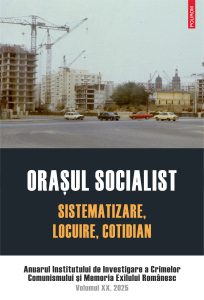
Volumul XX/2025 al Anuarului IICCMER este disponibil pe site-ul Editurii POLIROM.
CUPRINS
Prezentarea autorilor
Cuvînt înainte (Ștefan Bosomitu, Cristian Dumitrescu)
Secțiunea I – Transformări și dezvoltări urbane: sincope și discontinuități
Sistematizarea orașului Cluj(-Napoca) (1958-1976). Un proiect discontinuu (Ștefania BOCA)
Abstract
The article proposes a study on how socialist systematization served the purpose of defining—and especially hierarchizing—the built environment during the period of socialist urbanism, at the local level, in Cluj-Napoca. The desire for uniformity, which emerged with the establishment of the communist regime, persisted throughout its duration, though it found different methods of implementation through systematization. The paper addresses the chronology of the emergence of various forms of theoretical hierarchization during the studied period, as manifested through systematization, through unpublished archival documents. In doing so, it reveals the methods by which the city of Cluj-Napoca developed morphologically during socialism. Secondly, the article shows how political, economic, and legislative changes created discontinuities in the city’s development process, transforming the potential of theoretically coherent urban models into a succession of unsynchronized initiatives. The analysis of systematization projects in Cluj-Napoca ultimately highlights the tensions between political intent, architectural discourse, and practice. Thus, although hierarchization was pursued at the local level, the projects implemented in Cluj-Napoca demonstrate a series of unforeseen aspects in the city’s development. These include, on the one hand, the constant shifts in theoretical and political discourse, and on the other hand, a set of deficiencies present within the city. The case studies reveal certain administrative failures or systemic vulnerabilities, where central decisions were replaced by decisions made by local architects.
Ștei, singurul orașul nuclear al României comuniste. Istoria unei construcții strategice sovieto-române (1952-1989) (George DUMITRESCU)
Abstract
The city of Stei, in the Bihor County, known during the communist period as Dr. Petru Groza, was built around the uranium deposit in Baita-Plai, in the Apuseni Mountains. Due to this enormous wealth, the city has a unique history. The uranium, initially desired by the Germans, was exploited by the USSR for its own benefit beginning in 1952. Burdened by war debts and under the dominant influence of the Soviets, Romania agreed to the establishment of a Soviet-Romanian mining company. This was a legal form of economic subjugation, through which the entire quantity of uranium ore extracted until 1965 was sold at derisory prices to the Soviet Union. The city of Stei, the administrative seat of the company “Sovromkvarțit,” was built from scratch by the Soviets and became a nuclear city, a term given to cities in the Eastern Bloc that supplied uranium ore to the Soviet Union’s nuclear industry. The transformation of a simple mountainous rural community into a modern city occurred rapidly, in just a few years, through Soviet investments and unprecedented social changes that impacted the lives of several hundred thousand people. A substantial number of workers were relocated from various regions of Romania to participate in the ambitious Soviet Romanian mining project. They were separated from their families, abandoning their parents, traditions, and hometowns for a job in harsh conditions, in exchange for earnings that could be six times higher than the minimum wage at the time. This study examines the economic and architectural development of the city of Stei and the social changes of its inhabitants during the exploitation of the uranium deposit and throughout the communist period, until the fall of the regime in 1989.
Orașul Popești-Leordeni. O istorie a urbanizării controlate (Ilarion ȚIU)
Abstract
The article analyzes, through the method of historical investigation, the process of controlled urbanization of the locality Popești-Leordeni, starting with its establishment in 1908 and continuing up to the post-communist period. The study reconstructs the stages through which this locality was administratively integrated into the structure of the Capital (Bucharest), was subjected to forced industrialization during the communist era, and experienced, after 1989, accelerated, but incoherent, urban development. The research utilizes legislative, archival, and local documentary sources to highlight the tensions between centralized planning and the needs of the community. The main conclusion underscores the discontinuous and often conflictual nature of the “top-down” imposed urbanization, as well as the local adaptations that shaped the specific character of this suburb. The study offers a critical perspective on the long-term effects of administrative urbanization, proposing a reflection on the limits of this development model.
Renunțarea la realismul socialist în arhitectura românească. Studiu de caz: cvartalele „staliniste” bucureștene Vatra Luminoasă, Bulevardul Muncii și Drumul Taberei, 1954-1958 (Radu CARBARĂU)
Abstract
The imposition of socialist realism as a guiding principle for post-war Romanian architecture, together with the housing crisis caused by the war and forced industrialization, led to the construction, in the 1950s, of several residential complexes known as quartals throughout the country, but especially in Bucharest, where they were supposed to represent the city’s new architectural-urban direction. However, the construction of these quartals was out of sync with events in the USSR, seeing as the construction of many of Bucharest’s quarters had just begun in 1954, when Khrushchev criticized socialist realism. The Romanian reaction to Khrushchev’s speech is rather uncertain, which is why the quartals continued to be built without major changes. Certain ideas from Khrushchev’s speech, especially related to prefabrication and standardization, were, however, discussed more and more often in the Arhitectura RPR magazine, an official publication of the Union of Architects of the Romanian People’s Republic, until, in 1957, Khrushchev’s speech is reprinted, a sign of a paradigm shift. This study seeks to present the abandonment of socialist realism in Romanian architecture, following both the Soviet context and changes in Romania. Highlighting the increase in the number of articles that had the reduction of housing construction costs as their theme, as well as meetings of party and state organizations on the same theme, the study followed the way in which the plenary of 26-28 November 1958, considered the Romanian equivalent of Khrushchev’s speech of 1954, was “set up”. Finally, we followed the implementation of these changes in three Bucharest quartals selected as case studies.
Construcția metroului din București (1970-1989) (Mihăiță ENACHE)
Abstract
The Bucharest metro system was opened to the public on November 16th, 1979 with the first metro line between the Semanatoarea station (called since 2009 Petrache Poenaru) and Timpuri Noi station. The metro line was undoubtedly one of the most useful projects that were part of the urban development policies before 1989. This particular public transport system was a major undertaking and encompassed the efforts of 14 ministries, 18 different construction units, 48 research and design institutions and 44 manufacturing industrial units. It was planned and developed by Romanian specialists with Romanian technology. This was a requirement that came from Nicolae Ceausescu who seldom agreed to use imported technology, but who nonetheless had to agree to the latter in very specific circumstances. Since it was established in 1975, „Întreprinderea Metroul București” built 60 km of underground networks. In 1989 two new sections were being carried out – Leontin Sălăjan – Policolor and Basarab – Pajura – and they were initially scheduled to be open to the public in August 1991, but the end of the communist era saw their opening being delayed to the year 2000.
Secțiunea II – Aspecte ale cotidianul în urbanul socialist
Orașul București și muzeele sale la începutul regimului comunist (Cristian VASILE)
Abstract
The communist plan to integrate Bucharest’s museums into the architectural and urban planning network, conceived according to new ideological principles, was already visible immediately after December 1947. In the end, however, the communist officials did not adopt the solution of building new sites for the most representative museums, preferring to establish the main museum institutions (the Art Museum of the Romanian People’s Republic; History Museum of the City of Bucharest) in already built sites that only needed repairing, enlarging and reconfiguring (the former Royal Palace; the Suțu Palace). The article will shed more light on this political, ideological and legislative process concerning the establishment of the main museum exhibition sites in Bucharest, from the Universal Art Gallery to the National Gallery of Romanian Art and of Bucharest’s local History Museum. At the same time, the article focused on the profile of the above-mentioned Galleries and of the personalities who conceived them or were appointed as heads of the aforementioned museums (Professor George Oprescu, Marius Bunescu, M.H. Maxy). The aim of the article is also to underline the process of reconfiguration of the museum network in Bucharest, mainly in the period between 1946 and 1959, by using mainly the documents preserved at the National Historical Archives (in collections such as the Ministry of Arts and Information; Central Committee of the RCP – Agitprop Department), the Archive of the National Art Museum of Romania, as well as open sources (legislation, newspapers, exhibition catalogs, etc.).
Spațiile de joacă în România comunistă: receptare socială, simbolistică și proiecție a discursului ideologic (Maria-Teodora BALAȘ, Ștefan-Marius DEACONU)
Abstract
The article analyses how playgrounds in socialist Romania transformed from symbols of investment in children’s futures into degraded and often abandoned spaces. It highlights the official discourse that associated these spaces with the harmonious and healthy development of future generations. It also captures the discrepancy between urban plans and theoretical regulations, and the realities of an economic development model that no longer prioritised the well-being of citizens, particularly young people. This situation was exacerbated by austerity policies resulting from the decision to repay external loans in full. The marginalization of these playgrounds and the diffuse responsibility for their administration, shared between the state and citizens in the absence of clear commitments, is documented throughout the entire communist regime in Romania. Remarkably, the press criticized the negative aspects of these spaces, albeit in a controlled manner that avoided challenging the system. As in other areas, the role of specialists — in this case, architects or urban planners — was limited to standardization projects. Consequently, in the absence of resources, the execution and maintenance of these spaces were gradually transferred to the community. While the significant effort made to build an impressive number of playgrounds nationwide should be recognized, it should also be emphasized that, in relation to the objectives set by the communist regime, these remained more of a perpetual promise, periodically postponed under the pretext of more pressing priorities. Their decline reflected the macro contradictions of the socialist project at the micro level: a rhetoric of development marked by economic constraints, excessive centralization and the absence of institutional ownership.
Viața la bloc: între mizerie și confort. Reprezentări ficționale contemporane ale cotidianului comunist românesc în „cutiile de chibrituri” (Andreea ZAVICSA)
Abstract
This paper analyzes the fictional representations of everyday life in Romanian communist apartment blocks, with a focus on the final two decades of the Ceaușescu regime. Drawing on Henri Lefebvre’s concept of spatial triad (conceived, perceived, lived space), and further informed by the perspectives of Gaston Bachelard, Marc Augé, and Michel de Certeau on domestic space and everyday life, the study proposes an interdisciplinary approach to understanding how the apartment block is lived in, symbolized, and transformed narratively in postcommunist Romanian literature. The block is not treated as a mere backdrop but as a meaningful topos—a generator of identity and a shaper of behavior. The analysis addresses both the architectural and ideological dimensions of socialist housing and the ways in which domestic space reflects and distorts individual experience: cold, overcrowding, surveillance, but also intimate resistance and solidarity. The corpus includes works by some of the most prominent voices in contemporary Romanian literature, such as Mircea Cărtărescu, Gabriela Adameșteanu, Andreea Răsuceanu, Veronica D. Niculescu, Adina Popescu, and Dan Lungu, as well as by authors positioned on the periphery of the literary field, such as Doru Pop, Mihai Buzea, or Mara Wagner, who also explore this theme in their novels. The study proposes an interpretative typology of apartment blocks, based on how they are experienced and represented through the perspective of child and adolescent characters versus adult ones. Thus, postcommunist literature becomes a space of critical and poetic remembrance of communist everyday life, where the architecture of dwelling acquires identity-shaping, affective, and symbolic dimensions.
Secțiunea III – Sistematizare și transformări urbane în ultimul deceniu comunist
Transformarea unui „loc bizar” în „al doilea Herăstrău”: rolul brigadierilor în procesul de construcție al Lacului Morii (1975-1989) (Cristian DUMITRESCU)
Abstract
The development of Lacul Morii represented one of the most significant urban projects of the last decade of the communist regime, publicly presented by state propaganda as a “founding achievement” of the Nicolae Ceaușescu Era and, at the same time, as a major accomplishment of socialist youth. In reality, the massive involvement of brigadiers—pupils and students mobilized through the mechanisms of the Union of Communist Youth—was driven both by economic considerations, aimed at reducing construction costs through the substitution of specialized labor, and by political-educational purposes, intended to cultivate the values of “revolutionary romanticism” among young people. This study seeks to analyze the role attributed to youth within the framework of the National Youth Worksite for the Complex Development of the Dâmbovița River. The analysis is based on a diverse corpus of sources, including archival documents preserved at the National Archives of Romania, press articles, and contemporary testimonies, corroborated with the existing scholarly literature dedicated to youth worksites and to the systematization of the Dâmbovița River. The case of the National Youth Worksite at Lacul Morii illustrates the mechanisms through which the regime mobilized youth both as an economic resource and as a propagandistic instrument, the young brigadiers’ labor transforming a “bizarre place” into a space envisioned as “a second Herăstrău.”
Transformare și remodelare – cartierul evreiesc din București în calea sistematizării (Daniela MIHAI, Florentina UDREA, Simona DELEANU)
Abstract
This study explores a brief history of the Bucharest Jewish Quarter and presents some of the personalities and some of the important buildings built during the development of the area. The decline of the Jewish Quarter began with the repression to which the community was subjected and culminated with the demolition of a significant part of the neighborhood during the communist regime. What was saved today represents an important part of Bucharest’s architectural heritage.
Strada Mămulari, între demolări și salvare. Studiu de caz: demolarea Sinagogii A.B. Zissu și a Templului Unirea Fraterna si salvarea Templului Unirea Sfântă (Anca TUDORANCEA)
Abstract
Mămulari Street, whose name evokes the oriental heritage by referring to the small street vendors (mamul, in Turkish), is part of the history of professional streets, as was the parallel Sticlari Street. Currently, the two streets with different names have become Mămulari Street and Entrance, being connected and completely changing the 19th century reading. These places were predominantly inhabited by Jews, as evidenced by the multitude of synagogues existing and mentioned in documents, maps or photographs. Mămulari, a street with 3 synagogues, is a fractured, modified, but a surviving street of communist demolitions. The survival of the Holy Union Temple is linked to the fact that this place was already a museum since 1978 and because there were negotiations by Chief Rabbi Moses Rosen to preserve this place